


Russian and soviet cinema
Director,
Actor,
Character
Born in 1874, Russia
Died in 1940
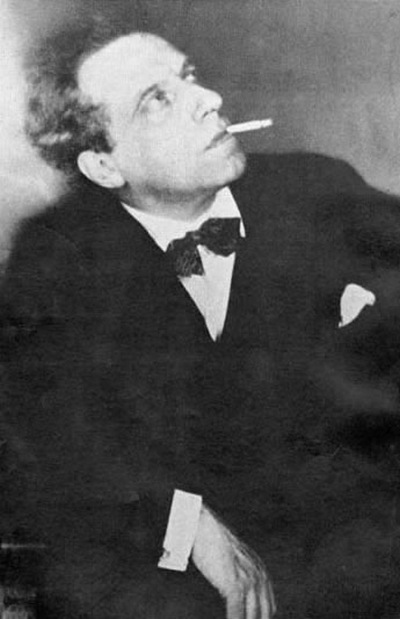
Vsevolod MEYERHOLD
▪ ▪ ▪ ▪ ▪ ▪ ▪
Всеволод Эмильевич МЕЙЕРХОЛЬД
Vsevolod MEYERHOLD

From filmography
Director
1917 - Silhyy chelovek (Сильный человек) [fiction]
1915 - Portret Doryana Greya (Портрет Дориана Грея) [fiction, 2124 m]
Actor
1928 - Belyy oryol (Gubernator) (Белый орел / Губернатор) from Yakov PROTAZANOV [fiction, 67 mn]
1917 - Silhyy chelovek (Сильный человек) from Vsevolod MEYERHOLD [fiction]
1915 - Portret Doryana Greya (Портрет Дориана Грея) from Vsevolod MEYERHOLD [fiction, 2124 m]
Character
2010 - 1978 god — Vasiliy Merkuryev. Istoricheskiye khroniki s Nikolayem Svanidze (1978 год — Василий Меркурьев. Исторические хроники с Николаем Сванидзе) from Sergey_3 ZHUKOV , Marina ZHUKOVA [documentary, 42.58 mn]
Sites : IMDb, frWikipedia
Biography
Vsevolod Emilievich Meyerhold (1874–1940) was one of the most significant figures in the history of Russian and Soviet theatre. His innovative approaches to theatrical art, his teaching methods, and his theoretical contributions greatly influenced the development of theatre not only in Russia but throughout the world.
Early Years and Education
Vsevolod Meyerhold (Karl Kasimir Theodor Meyerhold) was the eighth child in the Lutheran family of wine producer Emil Fyodorovich Meyerhold (d. 1892), from the Meyerhold von Ritterholm lineage. He was born on January 28 (February 9, New Style), 1874, in Penza. His father, Emil Karlovich Meyerhold, was a railway engineer and, according to Vsevolod himself, had Jewish roots, while his mother, Alvina Danilovna (née Neeze), a Baltic German, was a homemaker.
In 1895, Meyerhold graduated from the Faculty of Law at Moscow University, but his true calling was theatre. In 1896, he entered the Moscow Philharmonic Society, where he began studying acting.
The Beginning of His Theatrical Career
Meyerhold began his theatrical career in 1898, when he became an actor and director at the Moscow Art Theatre. In 1902, he founded his first theatre studio, where he began experimenting with new forms and methods of theatrical art. In 1905, Meyerhold founded the theatre Comedy, where he staged productions known for their innovative approach to stage space and acting.
Theatrical Experiments and Innovations
Meyerhold was one of the first directors to incorporate elements of cinema and circus into theatre. He developed the concept of the “theatre of the future,” which emphasized dynamism, physicality, and visual effects.
In 1913, he founded the “Theatre-Studio,” where he continued his experiments. In the 1920s, he created the “Meyerhold Theatre” in Moscow, where he staged productions that became classics of Soviet theatre.
Pedagogical Work
Meyerhold was also an outstanding teacher. He developed his own system of actor training, which included elements of physical movement, pantomime, and rigorous physical conditioning. His teaching methods had a significant impact on the development of acting both in Russia and internationally.
In the 1920s, Meyerhold founded the State Higher Directing Workshops (GVRM), where he trained young directors and actors.
Political Activity and Repression
In the 1930s, Meyerhold faced political repression. In 1938, he was arrested on charges of anti-Soviet activity. Even in prison, he continued working on theatrical projects and theoretical ideas.
In 1940, Meyerhold died in prison, officially from a heart attack, although many believe his death resulted from torture and abuse.
Legacy
Despite his tragic fate, Meyerhold left a rich legacy. His works and methods continue to be studied and applied in theatre schools and theatres around the world. Meyerhold is considered one of the founders of modern theatre, and his contributions to theatrical art are immeasurable.
His productions, such as Mystery-Bouffe (1918), Vladimir Mayakovsky (1921), and The Forest (1924), became classics and continue to be staged worldwide.
Major Works and Productions
• “Mystery-Bouffe” (1918) — a revolutionary production created in collaboration with Vladimir Mayakovsky. In this performance, Meyerhold used elements of pantomime, physical movement, and visual effects.
• “Vladimir Mayakovsky” (1921) — a production dedicated to the life and work of the poet Vladimir Mayakovsky.
commentaries
-
Горе уму, или, Эйзенштейн и Мейерхольд :
двойной портрет на фоне эпохи
, Lev ROSHAL,
2007, Материк - «Балаган лучше кинематографа». Комментарии к первому выступлению В.Э.Мейерхольда о кино [Le "balagan" meilleur que le cinéma", Meyerhold et le cinéma]
Владимир ЗАБРОДИН, 2006, kinozapiski.ru
-
Эйзенштейн о Мейерхольде
, Vladimir ZABRODIN,
2005, Новое издательство
Images
-
Эйзенштейн о Мейерхольде
, Vladimir ZABRODIN,
2005, Новое издательство
Images