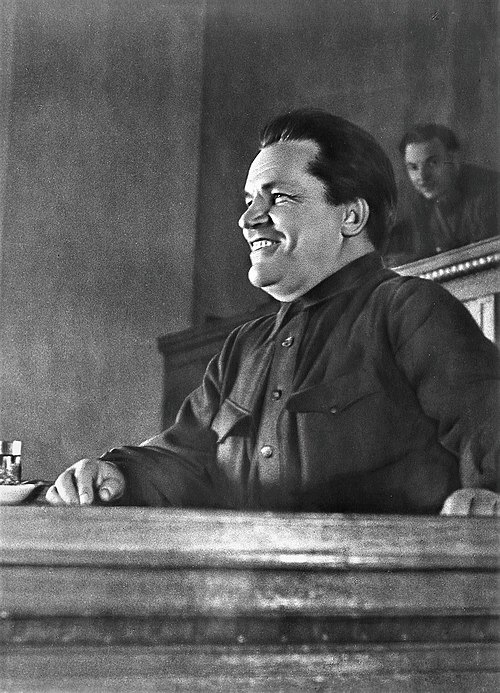
Birth and Childhood:
Sergei Mironovich Kirov was born on March 27 (April 8, New Style), 1886, in the town of Urzhum in the Vyatka Governorate (now Kirov Oblast, Russia). His parents, Miron Yefimovich Kostrikov and Maria Ilinichna, came from humble backgrounds: his father worked for the railway, while his mother was a homemaker.
As a child, Sergei helped his parents but also showed a keen interest in studying and reading.
Education:
In 1904, Kirov entered Kazan University, where he studied mathematics and physics. However, his revolutionary activities prevented him from completing his education. At the university, he joined a Social Democratic organization and became actively involved in revolutionary circles. Revolutionary Activity
Beginning of Revolutionary Involvement:
In 1904, Kirov joined the Russian Social Democratic Labour Party (RSDLP) and took an active part in revolutionary activities. He organized meetings, distributed revolutionary literature, and participated in strikes.
In 1905, during the First Russian Revolution, Kirov was arrested and exiled to Vologda, but he soon escaped abroad.
Emigration and Return:
During his emigration, Kirov continued his revolutionary work, participating in party organizations in Switzerland, Germany, and France. He was active in the foreign branches of the RSDLP and maintained connections with Russian revolutionaries.
In 1917, after the February Revolution, Kirov returned to Russia and took an active part in the October Revolution. He was one of the organizers of the armed uprising in Petrograd and played an important role in establishing Soviet power. Political Career
After the Revolution:
Following the October Revolution, Kirov held various party and government positions. He worked in party organizations in Astrakhan, Baku, and other cities.
In 1921, he was appointed First Secretary of the Astrakhan Regional Committee of the RCP(b). In Astrakhan, Kirov actively worked to restore the economy and improve living conditions for the population.
Work in Azerbaijan:
In 1920–1921, Kirov served as a member of the Revolutionary Committee of Azerbaijan and played an important role in establishing Soviet power in the republic. He contributed to organizing industry, agriculture, and education in Azerbaijan.
Work in Leningrad:
In 1926, Kirov was appointed First Secretary of the Leningrad Regional and City Committees of the VKP(b). This position marked a major stage in his career, making him one of the most influential politicians in the country.
In Leningrad, Kirov focused on industrial development, improving workers’ living conditions, and constructing new facilities. He also devoted great attention to cultural and educational matters, supporting the growth of science and the arts. Personality and Influence
Personal Qualities:
Kirov was known for his energy, charisma, and organizational skills. He was highly respected by party members and workers alike. His openness and accessibility made him popular among the general population.
He was also known for his modesty and simplicity in communication, which contrasted with the image of many other party leaders of the time.
Influence on Politics:
Kirov was one of the most popular leaders in the party and among the public. His work in Leningrad contributed to industrial development and improved workers’ living conditions.
He was also known for criticizing bureaucracy and corruption within the party. He advocated for democratizing the party and improving workers’ living standards. Death and Aftermath
Assassination:
On December 1, 1934, Kirov was assassinated at the Smolny Institute in Leningrad (now Saint Petersburg). His killer, Leonid Nikolaev, was arrested and executed.
Kirov’s assassination became the pretext for the mass repressions and purges in the USSR known as the “Yezhovshchina.” Stalin used the event to eliminate political opponents and strengthen his own power.
Monuments and Memorials:
In 1934, the city of Vyatka was renamed Kirov in honor of Sergei Mironovich Kirov.
Monuments and memorials dedicated to him were installed in various cities of the Soviet Union.
Legacy:
Kirov remains one of the most significant figures in Soviet history, and his name continues to be associated with the revolutionary and political events of that era.
Sergei Mironovich Kirov left a considerable mark on the history of the Soviet Union, and his life and work continue to be studied and analyzed by historians and political scholars.