Russian and soviet cinema
Character
Born 1862, Russian Empire
Died 1911
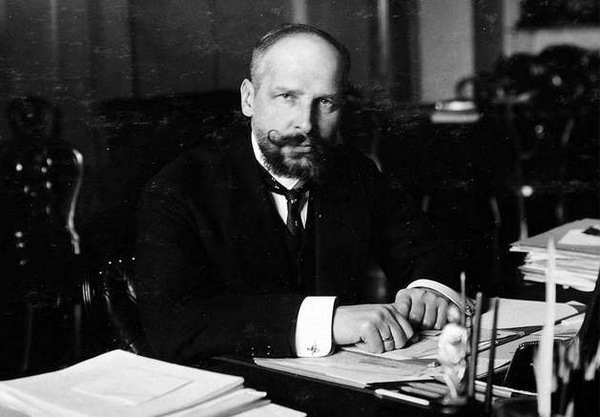
Piotr STOLYPIN
▪ ▪ ▪ ▪ ▪ ▪ ▪
Пётр Аркадьевич СТОЛЫПИН
Piotr STOLYPINE

Filmography (extracts)
Character
2003 - 1901 - The starting point. Historical chronicles with Nikolai Svanidze (1901 год — Точка отсчёта. Исторические хроники с Николаем Сванидзе) from Aleksey PANKOV [documentary, 43.51 mn]
2003 - 1909 - Yevno Azef. Historical Chronicles with Nikolai Svanidze (1909 год — Евно Азеф. Исторические хроники с Николаем Сванидзе) from Aleksey PANKOV [documentary, 43.47 mn]
2003 - 1911 — Pyotr Stolypin. Historical chronicles with Nikolai Svanidze (1911 год — Пётр Столыпин. Исторические хроники с Николаем Сванидзе) from Sergey GUSEV [documentary, 44 mn]
Sites : enWiki, ruWiki, frWiki
Biography
Pyotr Arkadyevich Stolypin (April 14, 1862 – September 1, 1911) was a Russian statesman who served as Prime Minister of the Russian Empire from 1906 until his assassination in 1911. Renowned for his ambitious agrarian reforms and his determined campaign against revolutionary unrest, he remains one of the most influential—and controversial—figures of late Imperial Russia.
Early Life and Education
Born into a family of hereditary landowners in the village of Grishino, in present-day Tula Oblast, Stolypin enjoyed the upbringing of the provincial gentry. He was educated at a classical gymnasium before entering the Faculty of Law at Moscow University. Upon graduating, he entered the civil service, holding a succession of administrative posts that honed his skills in governance and public order.
Rise in Provincial Administration
In the 1890s, Stolypin’s political career gathered pace when he was appointed governor of Grodno Province. As governor, he earned a reputation for decisiveness, combating revolutionary agitation with firm measures while maintaining stability.
In 1903, he was transferred to the governorship of Saratov Province, one of Russia’s most volatile agricultural regions. There, Stolypin combined a commitment to law and order with initiatives to improve peasant livelihoods, enhance agricultural output, and modernize rural administration. His success in Saratov brought him to the attention of the highest authorities in St. Petersburg.
Minister of the Interior and Prime Minister
In 1906, during the political turmoil following the 1905 Revolution, Stolypin was appointed Minister of the Interior. Within months, he was elevated to Prime Minister. Faced with mounting revolutionary violence and a fragile monarchy, Stolypin sought to stabilize the empire through a dual policy of reform and repression.
The Stolypin Reforms
His signature achievement was the agrarian reform program that bears his name. Determined to break the communal landholding system, Stolypin championed private ownership for peasants, enabling them to consolidate scattered strips into individual farms. He encouraged the creation of prosperous, market-oriented peasant households—the so-called kulaks—and offered incentives for migration to Siberia and the Far East, aiming to relieve population pressure and develop underpopulated territories.
These measures were intended to foster a loyal, property-owning rural class that would serve as a stabilizing force in the empire.
A Hard Line Against Revolution
While pursuing reform, Stolypin showed little tolerance for political extremism. He strengthened police powers, introduced field court-martials to expedite trials of accused terrorists, and suppressed revolutionary organizations with determination. His oft-quoted dictum, “First pacification, then reform,” encapsulated his vision for restoring order before modernizing the state.
Assassination and Historical Legacy
On September 1, 1911, while attending a performance at the Kyiv Opera House, Stolypin was shot by Dmitry Bogrov, a revolutionary double agent with links to the secret police. He died four days later. His assassination deprived the Russian Empire of a leader whose reforms, supporters believed, could have steered the country toward a more stable and prosperous path.
Stolypin’s legacy remains the subject of debate. Admirers regard him as a visionary reformer who sought to modernize Russia’s agrarian structure and strengthen the monarchy through social stability. Critics emphasize his reliance on repressive measures and his authoritarian style. Either way, his name endures as a symbol of both reformist ambition and the intractable political conflicts of early 20th-century Russia.
Commentaries
- Memory Politics in Contemporary Russia. Television, Cinema and the State
Mariëlle WIJERMARS, 2019, Routledge
Photos, videos, texts