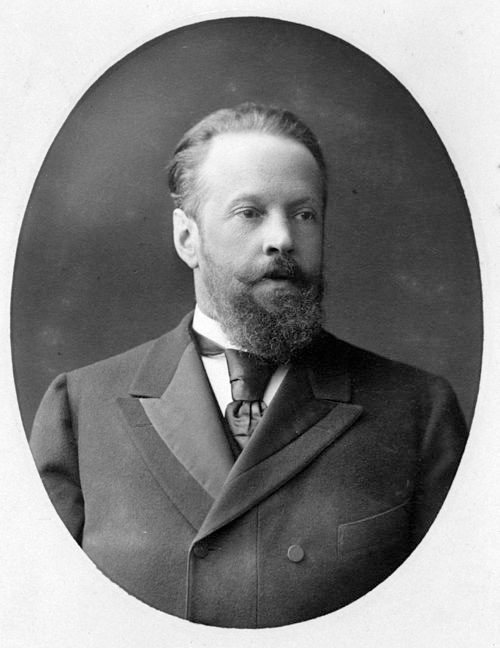
Sergei Iulievitch Witte (1849–1915) was a statesman, economist, and Russian Minister of Finance, known for his reforms and contributions to the economic development of the Russian Empire.
Sergei Witte was born on June 29, 1849, in Tiflis (now Tbilisi, Georgia) into a family of civil servants. He studied at the Royal School of Tiflis and then at the St. Petersburg Technological Institute, where he graduated in 1869.
Witte began his career in the railway industry, working on the Caucasus Railway. In 1889, he was appointed head of the Southern Russian Railway, where he proved to be an effective manager.
In 1892, Witte became the Minister of Finance of the Russian Empire. In this position, he implemented several important reforms aimed at modernizing the economy. He actively promoted foreign investments and industrial development, contributing to the industrialization of the country. Witte also played a key role in the construction of the Trans-Siberian Railway.
Witte was an advocate for the introduction of the gold standard, which helped stabilize the Russian currency. He also contributed to the development of reforms to improve the financial system and tax legislation.
After the 1905 Revolution, Witte became one of the main architects of the October Reforms, which led to the creation of the State Duma. He was appointed Chairman of the Council of Ministers in 1905 but quickly resigned.
After his resignation, Witte continued to participate in public life, dedicating himself to scientific and literary activities. He wrote memoirs in which he outlined his views on economics and politics.
Sergei Iulievitch Witte passed away on February 13, 1915, in St. Petersburg. His legacy remains significant in Russian history, particularly in the context of economic reform and industrialization.