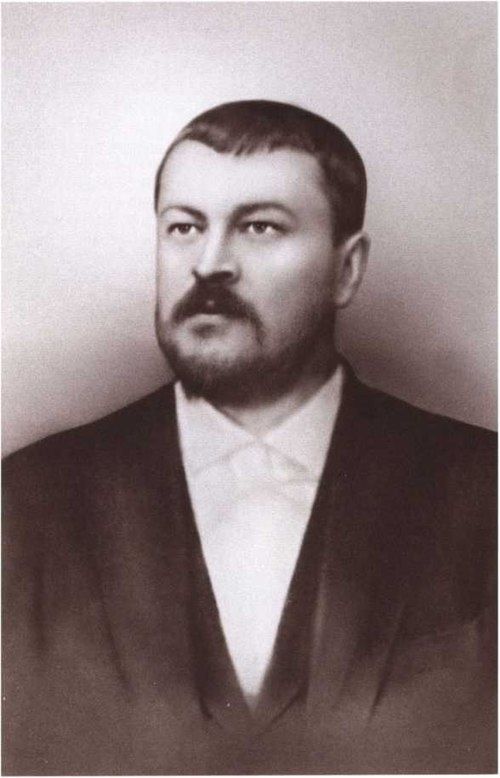
Savva Timofeevich Morozov was a hereditary honorary citizen. He spent his childhood in a mansion in Trekhsvyatitelsky Lane. He graduated from the 4th Moscow Lyceum near the Pokrovsky Gates (1881).
In 1881, he entered the Faculty of Physics and Mathematics at the Imperial University of Moscow, graduating in 1887 with a degree in chemistry. During these years, he wrote an important work, a study on dyes, and later came into contact with Mendeleev.
In 1883, he became one of the founders of the Russian Gymnastics Society.
From 1885 to 1887, he studied chemistry at the University of Cambridge (United Kingdom), while also learning about the organization of the textile industry in English factories (in Manchester).
From 1886, he was the general director of the Nikolskaya Manufactory "Savva Morozov Son and Co."
He loved his work and often challenged the famous aphorism "I think, therefore I am": "I do not agree with Descartes on this formulation. Thought is a process closed in on itself. It may not manifest itself externally, remain sterile and unknown to humans. We do not know what thought is in its mysterious essence, but we know its limits... I say: I work, therefore I exist. For me, it is obvious that only work expands and enriches the world and my consciousness" (p. 49).
In his factories, Morozov introduced paid maternity leave for female workers. He had his own scholarship students at the country's technical universities, and some of them studied abroad. Morozov's workers were better educated than those at other Russian industrial enterprises.
He was also the director of the Trekhgorny brewery in Moscow.
On June 24, 1888, Savva Timofeevich Morozov married his first cousin Sergei Vikulovitch's former wife, Zinaida Grigorievna Morozova; nine months later, their first son, Timofeevna, was born.
In 1890, Morozov acquired an estate in the Urals, in the village of Vsevolodo-Vilva, Perm Province. He was primarily attracted by the presence of forests, a source of raw materials for the production of chemical reagents. These reagents were needed to create new dyes used in manufacturing. In Vsevolodo-Vilva, Savva Morozov converted the old ironworks into a chemical plant. He opened another similar plant on the Ivaka River. The renowned biochemist Boris Ilyich Zbarsky later served as chief engineer of both plants.
In 1893, Morozov bought a house in Spiridonovka from Alexander Nikolayevich Aksakov, demolished it, and had a luxurious residence built for his wife according to the designs of architect Fyodor Osipovich Shekhtel.
Thanks to his erudition and active support for the interests of Russian commercial and industrial capital, he acquired considerable authority among the merchant class. In 1893, the Moscow bourgeoisie proposed him for the post of mayor of Moscow on the condition that he convert to Orthodoxy, but Savva Morozov refused. At the age of 28, he was elected chairman of the Nizhny Novgorod Fair Committee and held this position for two terms, often traveling to Nizhny Novgorod. In 1896, for successfully organizing the All-Russian Trade and Industrial Exhibition at the Nizhny Novgorod Fair, he was awarded the Order of St. Anna, 2nd Class.
At the beginning of the 20th century, he maintained relations with the leaders of the liberal movement. Semi-legal meetings of constitutionalists were held in his mansion on Spiridonovka, built between 1893 and 1898 for his wife Zinaida Grigorievna Morozova.
Morozov was also connected to the revolutionary movement. He financed the publication of the underground Social Democratic newspaper Iskra, devoting, according to Maxim Gorky's recollections, approximately 24,000 rubles a year to it. It was with his funds that the first legal publications of the Bolshevik newspapers Novaya Zhizn (New Life) and Borba (Struggle) were organized. Morozov smuggled banned literature and type into his factory. In 1905, he hid one of the Bolshevik leaders, Nikolai Ernestovich Bauman, from the police. He was friends with Maxim Gorky and knew Leonid Borisovich Krasin well.
Savva Timofeevich Morozov always closely monitored the situation of the workers in his factory. He personally examined the lists of hired and fired workers. If he noticed any irregularities