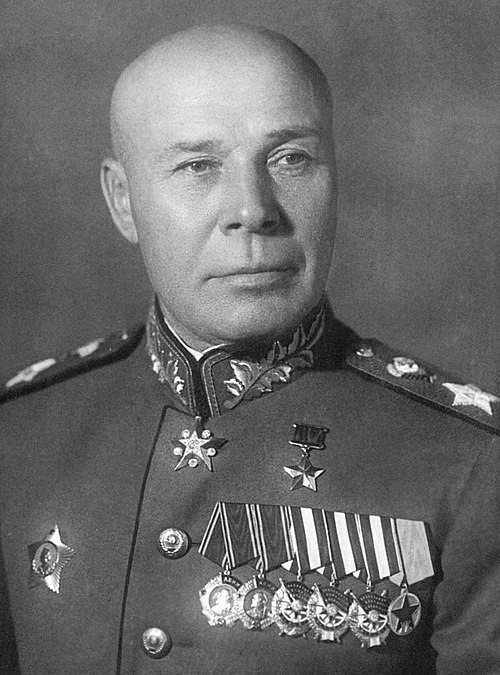
Timoshenko, Semyon Konstantinovich
(born February 18, 1895 – died March 31, 1970)
Born in the village of Furmanivka, Kiliya District, Odessa Region. Died in Moscow.
Soviet statesman and military commander.
Marshal of the Soviet Union (1940).
Twice Hero of the Soviet Union (March 21, 1940, and February 18, 1965).
He served in the Russian Imperial Army from 1915 as a private. During World War I he fought on the Western Front.
He joined the Red Army in 1918. He completed the Higher Academic Courses (1922–1927) and the Courses for Commanders at the Military-Political Academy (1930).
Civil War
During the Civil War, Timoshenko commanded a platoon and a squadron, fighting against interventionists and White forces in Crimea and the Kuban.
From August 1918, he commanded the 1st Crimean Revolutionary Regiment, which took part in the defense of Tsaritsyn; from November, he led the 2nd Separate Cavalry Brigade; and from October 1919, the 6th Cavalry Division, which, as part of the 1st Cavalry Army, distinguished itself in battles near Voronezh, Kastornoye, Rostov-on-Don, Bataysk, Yegorlykskaya, Maykop, Zhitomir, and Brody.
From August 1920, he commanded the 4th Cavalry Division, successfully combating the forces of General Wrangel and the armed formations of Nestor Makhno.
For his successful command, courage, and heroism during the Civil War, he was twice awarded the Order of the Red Banner.
Interwar Period
Beginning in 1925, Timoshenko commanded the 3rd Cavalry Corps.
From August 1933, he served as deputy commander of the Belarusian Military District.
From July 1937, he commanded the North Caucasus Military District; from September, the Kharkov Military District; and from February 1938, the Kiev Special Military District.
Drawing on his extensive Civil War experience, he proved an effective organizer of combat training.
In September 1939, troops of the Ukrainian Front, under his command, marched into Western Ukraine.
During the Soviet–Finnish War of 1939–1940, beginning in January 1940, he commanded the North-Western Front, whose forces broke through the Mannerheim Line.
For his outstanding achievements, Timoshenko was awarded the title Hero of the Soviet Union.
From May 1940, he served as People’s Commissar of Defense of the USSR.
World War II
During the Great Patriotic War, Timoshenko distinguished himself as an experienced and capable commander. His service was marked not only by setbacks but also by major victories.
In June–July 1941, he served as People’s Commissar of Defense and Chairman of the Headquarters of the High Command (until July 1941).
He then became a member of the Headquarters of the Supreme Command and the Supreme High Command.
From July to September 1941, he commanded the Western Direction; from September 1941 to June 1942, the Southwestern Direction.
At the same time, he commanded the Western Front (July–September 1941) and the Southwestern Front (September–December 1941 and April–July 1942).
Under his leadership, the Soviet counteroffensive near Rostov-on-Don in 1941 was planned and executed.
In July 1942, he commanded the Stalingrad Front, and from October 1942 to March 1943, the North-Western Front.
Troops of the North-Western Front under his command eliminated the Demyansk Pocket.
From March 1943, as a representative of the Headquarters of the Supreme Command, he coordinated the actions of the Leningrad and Volkhov Fronts (March–June 1943), the North Caucasus Front and the Black Sea Fleet (June–November 1943), and the 2nd and 3rd Baltic Fronts (February–June 1944).
From August 1944 until the end of the war, he coordinated the 2nd, 3rd, and 4th Ukrainian Fronts.
He took part in the planning and execution of several major operations of the Great Patriotic War, including the Jassy–Kishinev Operation.
After the War
After the war, Timoshenko commanded the Baranovichi Military District (1945–1946), the South Ural Military District (1946–1949), and the Belarusian Military District (in 1946 and again from 1949 to 1960).
From April 1960, he served as General Inspector of the Group of General Inspectors of the USSR Ministry of Defense, and beginning in 1961, concurrently as Chairman of the Soviet Committee of War Veterans.