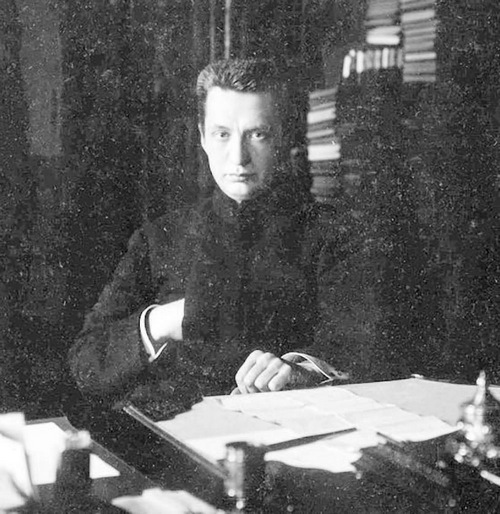
Alexander Fyodorovich Kerensky (1881–1970) was a Russian political figure, lawyer, and revolutionary who played a key role in the events of the February and October Revolutions of 1917. He was one of the leaders of the Provisional Government and became a symbol of the transitional period in Russia’s history.
Early Life and Education
Alexander Kerensky was born on April 22, 1881, in Simbirsk (now Ulyanovsk) into a teacher’s family. He studied at the Faculty of Law of Saint Petersburg University, where he was actively involved in the student movement. After graduating in 1904, Kerensky began his career as a lawyer, quickly earning a reputation as a defender of political prisoners.
Political Career
Kerensky became a member of the Socialist Revolutionary Party (the SRs) and actively participated in revolutionary activities. He was elected to the State Duma, where he advocated for reforms and social change. After the February Revolution of 1917, which overthrew the monarchy, Kerensky became one of the leaders of the Provisional Government, serving first as Minister of Justice and later as Minister of War.
The Provisional Government
The Provisional Government, in which Kerensky played a central role, faced numerous problems, including an economic crisis, unrest among workers and peasants, and the growing influence of the Bolsheviks. Kerensky attempted to maintain power and stabilize the situation, but his actions were often criticized. He supported Russia’s continued participation in World War I, which caused discontent among soldiers and workers.
In July 1917, Kerensky became Prime Minister. He attempted to implement a number of reforms, including agrarian reform and improvements for workers, but his efforts did not produce the desired results. During this period, the Bolsheviks, led by Vladimir Lenin, were gaining popularity by promising “peace, land, and bread.”
The October Revolution
In October 1917, when the Bolsheviks carried out their coup, Kerensky found himself in a difficult position. He attempted to organize resistance, but his efforts were unsuccessful. On October 25 (November 7 in the new style), the Bolsheviks seized power, and Kerensky was forced to flee Petrograd. He left the city and soon joined the army, where he continued to fight against the Bolsheviks.
Exile and Later Years
After the defeat of the White forces in the Civil War, Kerensky emigrated to Europe, first to France and then to the United States. In exile, he continued to speak as a political figure, though his influence greatly diminished. Kerensky worked as a lecturer and wrote memoirs in which he analyzed the events of the revolution and his role in them.
Alexander Kerensky died on June 11, 1970, in New York. His life and activities remain subjects of study and debate, and his figure symbolizes the complex and contradictory processes that took place in Russia at the beginning of the 20th century.
Legacy
Kerensky became a symbol of the transitional period in Russian history, embodying hopes for democratic reforms and social change. His actions and decisions as the leader of the Provisional Government continue to spark debates among historians. Some view him as a man who tried to preserve Russia during difficult times, while others criticize him for lacking decisiveness and failing to prevent the Bolsheviks’ rise to power.
Kerensky remains one of the key figures in Russian history, and his legacy continues to be studied both in Russia and abroad.