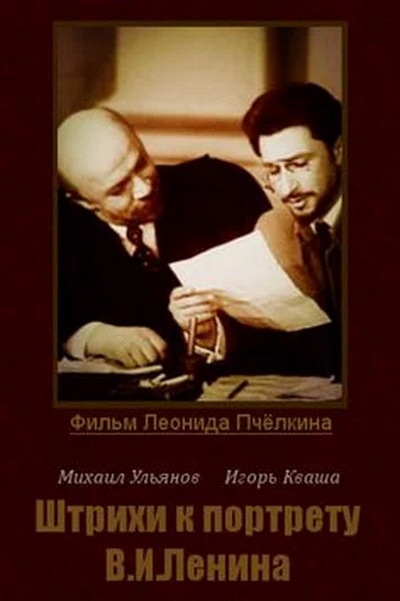
Note : This four-part television series, filmed in 1967-70, was not shown until 1987.
Plot synopsis
Film one: "Roll-call vote". The film tells about the Extraordinary Fourth All-Russian Congress of Soviets held in March 1918, at which the Brest-Litovsk Peace Treaty was ratified, about V.I. Lenin's speech at the congress.
Film two: "An Hour and a Half in Lenin's Office". The film depicts one of the most dramatic periods in the life of the young Soviet Republic, when the armed Socialist Revolutionary rebellion disrupted the respite needed to organize the country's economy.
Film three: "Air of the Council of People's Commissars". The film tells of one day of V.I. Lenin in September 1918, when, after an illness caused by a wound, doctors allowed him to work. On this day, V.I. Lenin dictates an article "On the Character of Our Newspapers" to M.I. Ulyanova, meets with his comrades.
Film four: "The VKHUTEMAS Commune". The plot of the film is based on V.I. Lenin's speech at the III All-Russian Congress of the Russian Communist Youth Union and V.I. Lenin and N.K. Krupskaya's visit to the Higher State Art and Technical Workshops.
Commentaries
The French journal Études soviétiques, in its issue No. 469 of August 1987, published an article by Alexandre Egorov entitled Sketches for a Portrait of Lenin, from which we reproduce below extensive excerpts:
Translation by Kinoglaz.fr
“For twenty years, four films from the cycle Sketches for a Portrait of Lenin, based on Mikhail Shatrov’s screenplay, remained on the shelves. One day, an order was even given to destroy them, but the films were saved... Now they have been broadcast on television and ‘all of Moscow’ is discussing them. The films have been able to contribute to the ongoing restructuring in the country, since their author’s position—honest, open, historically authentic—has made them extremely relevant.
These films show Lenin engaged in fierce political struggle not only against sworn enemies but also, at times, in disagreement with his comrades-in-ideas or, more often, with fellow travelers—temporary allies, each with his or her own convictions and authority: Spiridonova, Kamkov, Martov, Kollontai, Bukharin.
‘We do not need such names in our History,’ was declared at the time the films were banned. What was feared was not so much the names themselves, which appeared in the Party’s history textbooks, but the scale of their polemics with Lenin as presented on screen. What was dreaded was the clarity, free of exaggeration, that allowed viewers to see Lenin’s opponents as people with their own opinions—narrower, true, but inspired by the complex reality of the revolution. Their views pushed some into the enemy camp, while others eventually sided with Lenin.
We are in absolute need of this vision of history, and of this artistic analysis and interpretation of its contradictions, in order to understand the logic of the revolutionary process, as well as to take a clear position in the current debate with our ideological adversaries who, as in the time of the Brest-Litovsk Treaty (signed in 1918, which stripped Soviet Russia of part of its territory and forced it to pay financial reparations—Editor’s note) and the NEP (the New Economic Policy, adopted in 1921, which permitted a certain development of capitalist elements while preserving the Soviet state’s economic levers—Editor’s note), jubilantly proclaim that the ‘Bolsheviks are retreating.’ We also need this in our internal disputes with those who sincerely believe that economic restructuring undermines the foundations of socialism. An exaggeration? Not at all. For this is the same revolutionary extremism that Lenin so forcefully condemned.
This idea is already suggested in the first film of the cycle, Voting by Individuals, which deals with the polemic surrounding the Brest-Litovsk Treaty. The other three films, half-artistic, half-documentary, charged with the same energy, also stimulate reflection. The film An Hour and a Half in Lenin’s Office reproduces the dramatic situation of the final break with the Left Socialist Revolutionaries (after the assassination of Mirbach, the German ambassador to Russia, and on the eve of the July uprising). The Air of the Sovnarkom conveys the extraordinary atmosphere of the Bolsheviks’ remarkably well-organized work. The final film, The Vkhutemas Commune, recalls Lenin’s meeting with young revolutionary artists.
The film censors were shocked, among other things, by the frank attack launched in The Air of the Sovnarkom against the cult of personality as a phenomenon that probably caused the gravest distortions of socialist doctrine and practice.
After a long illness following Kaplan’s assassination attempt, the doctors allowed Lenin to return to work. He was eager to regain his office and the Sovnarkom meeting hall. Only one thing dampened his enthusiasm: everywhere he noticed excessive attention to his health and to himself...
Modesty? Well then, let us stop speaking only of modesty, for this is something much more important. For Marxism, the refusal to glorify any particular figure, any ‘hero,’ is a matter of principle. Lenin was, of course, conscious of his role and authority in the country and among the people, but he understood that the tendency toward leader-worship, inherent in Russian consciousness and rooted in centuries of veneration of the tsar, had to be rejected by the revolutionary party as an obstacle to the creativity of the masses—the only reliable driving force of progress.
Relapses of the psychology of the personality cult era remain alive even despite the current climate of restructuring. Some leaders still interrupt their subordinates during meetings while everyone else remains silent. I also do not understand why in the new film Korolev, about the chief designer of spacecraft, we see a majestic Stalin in the uniform of a generalissimo welcoming scientists. Of course, it is not a matter of eliminating this name, as has already been done with dozens of others that have been erased or even blackened, but making him an attribute of glorious scenes is hardly any better. Stalin certainly understood the importance of technical progress, but from this pathetic context it is only one step to ‘Stalin’s eagles,’ ‘Stalin’s artillery,’ and the ‘Stalinist conquest of nature’ (we know what the latter cost us).
Have we digressed from our subject, The Air of the Sovnarkom? Not at all, since it is this film that prompts such reflections. I may be reproached, of course, for praising too much—ah, this mania for cults!—this honest, indispensable, and in a certain sense innovative work, whose artistic shortcomings are no less obvious than its merits. We see, for example, images that are too pale of certain historical figures who would deserve a stronger interpretation. That of Yevgeny Yevstigneyev, who plays Lunacharsky, strikes by its physical dissimilarity. At the same time, if the films lacked artistic merit, they would not deserve discussion despite the relevance of their themes. But their merits are obvious. Director Leonid Ptchyolkin, with a few exceptions, has achieved an intelligent and authentic interpretation. One feels the actors’ passion for the problems they portray, in the same way as in Shatrov’s stage plays. Particularly notable are Oleg Tabakov (Bukharin), Oleg Yefremov (Martov), and Igor Kvasha (Sverdlov). Ulyanov in the role of Lenin is excellent and would deserve an article devoted to him.”