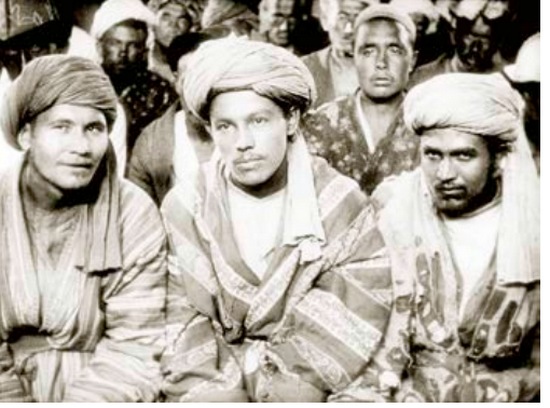
In 1928, collectivization began in earnest in the Soviet Union.
Peasants were called upon to unite their farms and create
agricultural artels (associations) to counter large landowners.
The theme was a common one in Soviet propaganda films of
the era; those made in Uzbekistan differed little from similar
agit-prop produced by other studios. In general they featured
rallies and meetings seen to galvanize characters who are
merely abstract carriers of ideas rather than fleshed-out figures.
Arabi fits this mold, combining propaganda with instructionaltechnological displays designed to showcase a collective’s
success in cultivating the highest quality Karakul sheep.
Nina Zubova uses mostly non-professional actors to tell the
story of a “bai” (a word usually denoting a village landholder
or traditional member of a feudal elite) who cheats the sheep
breeders he hires. Outraged, the workers leave him and organize
their own partnership, the artel “Arabi”, which raises Karakul
sheep. In turn the bai’s henchmen try to ruin the collective’s
hard work by spoiling their well on the steppe and infecting
the sheep. In the end, the forces of progress prevail and the
artel begins to successfully process Karakul pelts at a Bukhara
tannery.
Through images as well as an abundance of intertitles and
inserts, the film shows in detail sheep farming practices as well
as its by-products, such as sheep cheese production, gathering
wool, skinning carcasses, and tanning hides. In addition, there
are shots of a modern veterinary laboratory creating a sheep
vaccine. An experimental sheep-breeding station is promoted as
a model for the collective’s farmers, who come to understand
that only by uniting in an artel and taking advantage of the
latest scientific advancements can they obtain the best Karakul
breeds. – Nigora Karimova