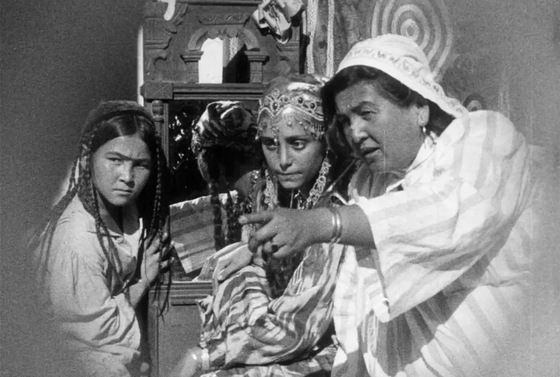
Early years of Soviet power in Central Asia. The wealthy merchant Tajibai takes a second wife, Adoliat. In her new home the young woman suffers from the cruelty of her husband and his first wife. ...
Commentaries
"The Second Wife" is based on a story by acclaimed writer
Lolakhon Saifullina (1901-1987), born Lidiya Osipovna
Sivitskaya, a Polish national who took the Uzbek name Lolakhon
upon marrying a Muslim and converting to Islam. Noted for her
collections of poems and stories, she was also a staff member
at the Sharq Yulduzi studio (the home of Uzbekgoskino)
between 1925 and 1928, and wrote scripts distinguished by
their sensitivity to Uzbek women’s issues. Her co-writer on "The
Second Wife", Valentina Sobberey (1891-1978) began at Sharq
Yulduzi as a legal consultant.
The themes they tackled here dwelt on the evils of early
marriage and polygamy, which remained common practice in
Central Asia despite Soviet campaigns to eradicate the practice.
Director Mikhail Doronin (1880-1935), a filmmaker since 1915,
avoided the Orientalizing gaze of many other directors tackling
“Eastern” themes, discarding exoticism in his depiction of
everyday life. Rich in details, the film is distinguished by its
striking construction of shots in which one senses a persistent
search for the most expressive angles. Especially noteworthy
is how cameraman Vladimir Dobrzhanskii uses light, such as
when a bunch of grapes, penetrated by the sun’s rays, turn
almost transparent and are subsequently plucked by the heroine
Adoliat (her name sounds like the Uzbek word for “justice”). As
a smile plays on her sun-struck face, the camera pans to reveal
that everything is filled with sunshine and beauty, but the girl’s
happiness is short-lived
Young Adoliat is given in marriage to the merchant Tajibai as
his second wife, but his infertile first wife, Khadycha, does
everything to turn the newcomer’s life into a living hell. As
the youngest of the wives, and from a poor family, Adoliat is
burdened with all the household chores, even after giving birth
to a daughter, Saodat (the Uzbek word for “happiness”). One
day when Tadzhibai is away from home, his paedophile brother
Sadiqbai (played by the director) steals money; Adoliat is
accused and she runs away to her parents’ house. But Tadzhibai
brings his rebellious wife home, where he separates her from
Saodat and locks her in the basement. A fire from the hearth
engulfs the basement and Adoliat dies in the flames.
Paralleling this tragic story is a side plot involving Kumry and
Umar, representatives of new Soviet youth. This binary of “Soviet
= good” and “traditional = bad” is reflected in almost all films of
the period, frequently expressed through the juxtaposition of an
unhappy Uzbek woman oppressed by her husband and traditions,
and, in contrast, a happy emancipated Soviet woman. The latter is
educated and financially independent, spending free time visiting
museums and clubs and sporting modern clothes and hairstyles.
The endings for each film depend on whether the heroine makes
the “ideologically correct choice”. Thus The Muslim Woman
(Musulmanka, Мусульманка, 1925) and The Jackals of Ravat
(Shakaly Ravata, Шакалы Равата, 1927) have happy endings
because in each a subjugated woman turns to her Soviet comrades
and is saved from her benighted husband’s oppression, whereas
the passive Adoliat dies despite her Soviet comrade’s attempts to
save her. The propaganda could not be clearer.
Adoliat is played by Raisa Messerer (Rakhil Mikhailovna
Messerer-Plisetskaya, known as Ra Messerer), mother of famed
ballerina Maya Plisetskaya and a member of the company at
the Sharq Yulduzi studio between 1925 and 1927. (After her
husband Mikhail Plisetski was “purged” by Stalin in January
1938, she was arrested that March as the wife of “an enemy
of the people”; once released in 1941 her career was at an
end, although she lived until 1993.) The actress plays the part
with extreme reserve, allowing only her eyes to capture her
pain. The film’s best scene comes when Tadzhibai takes Adoliat
back, as is his right under Sharia law. As he whips his horse
forward, Adoliat runs ahead with her child, her burqa tangled,
stumbling from fatigue. Tears roll down her sweaty face yet an
indescribable beauty surrounds them: the bright sun, mountain
slopes covered with a carpet of greenery, the shiny ribbon of the
river beckoning, all contrast with human cruelty.
Female roles in Uzbek cinema went to Russian and Tatar
actresses, but The Second Wife marks the appearance of
Uzbek actresses for the first time (Uktamkhon Mirzabaeva and
Zuhra Iuldashbaeva, popular folk singers in their day). “More
than 300 Uzbeks and Uzbek women took part in the shooting
of mass scenes,” reported Pravda Vostoka (11.01.1927).
“Many people came, thinking that they would be given some work;
after much persuasion, women took off their chachvon [full
face covering], revealing their faces, but when they learned they
were going to be filmed, and with their faces revealed in front of
unfamiliar men, they simply ran away!” Uzbek women still wore
the burqa, and appearing unveiled in public places, especially
on stage or on screen, could literally be a death sentence, as
happened to Nurkhon Iuldasheva and Tursuna Saidazimova,
young theatre performers who died at the hands of their
relatives after being recognized on stage in the late 1920s.
“What can the viewer expect from this new movie of Uzbek
cinema?” asked Qizil Uzbekiston (20.06.1927). “He will not be
captivated by the picture, for its plot is primitive, too familiar,
and by the end it fades away. But the clear photography of
cameraman V. Dobrzhanskii successfully captured authentic
fragments of daily life that will definitely make a great impression.
The director Doronin, a new man for Uzbekistan, could not fully
penetrate the life of Central Asia, but there is no doubt that he
did not distort this life, and created something close to being
authentic. The Second Wife is a picture for Uzbekistan. They
will understand it. As for those in Europe, the movie will be of
ethnographic interest there….” – Nigora Karimova